Lou Steinmetz
Straight ManLou Steinmetz is a campus-security official whose recurring encounters with William Henry Devereaux, Jr. place him at the boundary between campus disorder and institutional control. He appears first as the source of a suspicious, unexplained summons, then as an investigator ready to suspect a professor in the campus goose killing, and later as an officer pressing to speak with a student. Across these episodes, his authority is visible, but its limits are just as important: he can direct a crowd to disperse, yet he retreats when challenged over his right to enter a classroom.
Identity and First Appearance
William Henry Devereaux, Jr. recognizes Lou by reputation before identifying him by voice. During an early-morning call, the voice asking for Dr. Devereaux sounds thick, slow, and dogged, as though its owner believes he possesses information the other person lacks. The quality reminds William Henry Devereaux, Jr. of Lou, and the caller soon confirms that it is indeed him. The time—six-thirty on a Monday morning—and Lou’s request that the professor come to campus give the call the air of an official summons, though Lou offers no immediate explanation.
When William Henry Devereaux, Jr. asks what has happened, Lou describes it only as a campus incident. He says he is not authorized to provide more information. This guardedness establishes a pattern: Lou controls what he will disclose and makes institutional procedure part of the encounter. The lack of detail leaves the professor to imagine that he may be expected to surrender to authorities, an impression sharpened by the abruptness of the call. Lou does not clarify the matter until the professor learns from Teddy Barnes that a goose has been killed and hung from a campus tree.
The Goose Killing and Suspicion
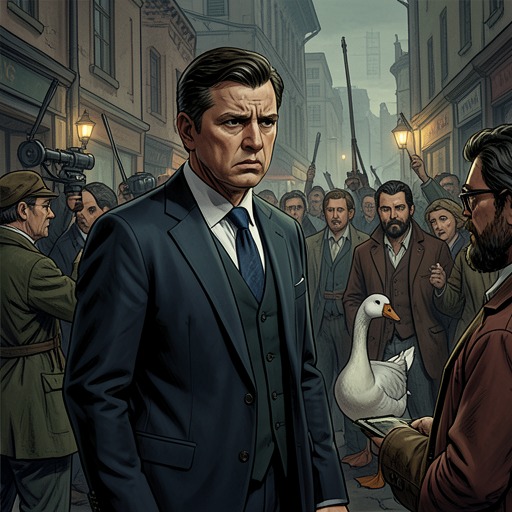
Lou’s connection to the campus animal incidents begins with suspicion rather than demonstrated evidence. According to Teddy Barnes, a member of campus security named Randy was at the desk when the goose killing was reported. Randy then called Lou, whose immediate response, as relayed by Teddy, was to suspect the “beatnik English professor.” The accusation reflects the ease with which William Henry Devereaux, Jr.’s public persona becomes a ready explanation for a disturbing campus event; the evidence presented does not establish Lou’s basis for believing he was responsible.
Lou’s suspicion belongs to a wider conflict in which a dead campus goose and the professor’s provocative public conduct have become entangled. Later, after another duck has died, Paul Rourke tells William Henry Devereaux, Jr. that Lou has appeared on local news claiming that authorities know the perpetrator’s identity. Lou does not name the professor in the interview, according to Rourke. The distinction matters: suspicion has made the professor a conspicuous target, but the reported broadcast stops short of publicly identifying him. Lou’s role in these episodes is therefore not simply to accuse; he also occupies the space between rumor, investigation, and the incomplete information available to the campus.
Crowd Control and Public Authority
During a filmed campus confrontation, the demonstration turns openly hostile after the camera light goes off. Someone calls William Henry Devereaux, Jr. a murderer, and another voice urges that he be arrested. Lou makes his way through the demonstrators and tells them to disperse. They do so, though reluctantly. The action is direct and effective: the crowd breaks up at his instruction, and Lou then approaches the professor to ask for a moment of his time.
William Henry Devereaux, Jr. reads Lou’s presence through his own skeptical perspective. Lou seems to him like an aging man with few remaining opportunities to suppress student revolt, and the prospect of detaining a radical English professor appears, in the professor’s imagining, to offer some compensation. That judgment is not presented as Lou’s stated motive. What the scene shows more concretely is a security officer moving from crowd management to an attempted encounter with the professor, while the professor refuses to stop for him. Lou says he could insist, but the exchange ends without showing him carrying out that threat.
The Classroom Boundary
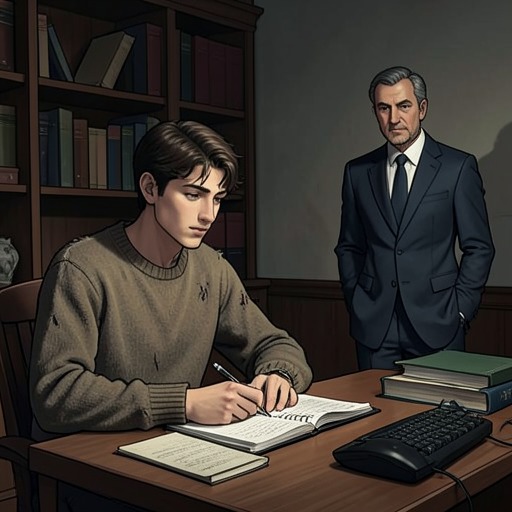
Lou later arrives at a class with a uniformed officer and asks to speak to one of the students, Leo. A campus-security car has pulled up outside; the officers cross the lawn, and another campus cop takes a position beyond the classroom windows. The arrival interrupts a workshop in which the students are already focused on Leo. When Leo begins gathering his belongings, William Henry Devereaux, Jr. tells Lou that the student can wait until class is over.
The professor interprets Lou’s approach as an attempt to exceed his authority: Lou has entered without knocking and has no business opening the classroom door, in William Henry Devereaux, Jr.’s view. That assessment belongs to the narrator, but the ensuing exchange makes the practical limit plain. Lou pauses, then agrees to wait in the hall rather than remove Leo immediately. His suggestion that the officers take chairs receives a firm refusal from the professor, and Lou does not force his way farther into the room. By the time William Henry Devereaux, Jr. later finds the hallway empty, Lou is gone and has his suspect. The text presents this as Lou having restored order, without detailing what happens to Leo afterward.
Character and Narrative Role
Lou is drawn through the friction between procedural opacity and visible action. He withholds information during the early-morning call, is associated with a rapid suspicion of William Henry Devereaux, Jr., asserts himself amid a hostile crowd, and seeks access to a student during class. Yet these episodes do not make his authority absolute. He can disperse demonstrators, but the professor can refuse his request for attention; he can arrive with another officer to question Leo, but he accepts the demand to wait outside the classroom.
The character is also filtered through William Henry Devereaux, Jr.’s acerbic, distrustful narration. The professor imagines Lou as an old-fashioned cop eager to crush dissent and later judges that he behaves like a bad officer who pushes beyond his authority until challenged. Those descriptions reveal the narrator’s interpretation, not an independent account of Lou’s inner motives. The more firmly established pattern is behavioral: Lou is persistent, economical with information, and willing to act in moments of campus conflict, but he can also retreat when another person contests the scope of his power. His appearances turn security into a recurring test of who may define order—and where institutional authority must stop.